


We’ve all been there: you’re trying to fold laundry or answer a quick email, and your preschooler is tugging at your sleeve for the tenth time. It’s tempting to think of “learning” as something that only happens when a child is sitting still with a workbook, but for the three-to-five-year-old crowd, that couldn’t be further from the truth. At this age, their brains are like sponges, and their primary language isn’t English—it’s play.
Educational games aren’t just a way to keep them busy; they are the building blocks of cognitive development. When a child plays a game, they aren’t just “having fun.” They are testing hypotheses, practicing fine motor skills, and learning the incredibly difficult social art of taking turns without having a meltdown. Let’s dive into why these games matter and how you can turn your living room into a low-stress learning lab.
How Games Build Brain Power Without the Boredom
Preschoolers have an attention span that can be measured in seconds, not minutes. That is why traditional “teaching” often flops. Educational games work because they provide immediate feedback and high engagement. When a child plays a matching game, they are practicing visual discrimination—the ability to see differences in shapes and colors—which is a direct precursor to reading letters like ‘b’ and ‘d’.
Furthermore, games introduce the concept of “executive function.” This is a fancy term for a child’s ability to plan, focus, and remember instructions. Whether it’s a digital app that asks them to sort fruit or a physical game of “Simon Says,” they are training their brains to hold onto information and execute a task. It’s basically a gym workout for their frontal lobe, but with more giggles.
Physical Games That Get the Wiggles Out and the Brains Growing
You don’t always need a screen or a battery-operated toy to teach complex concepts. Some of the best educational games are the ones that get kids moving.
Scavenger Hunts for Literacy and Math
One of the easiest games to set up is a “Color and Shape Hunt.” Give your child a basket and ask them to find “three blue things” or “two round things” around the house. This simple task teaches counting, categorization, and adjectives. If you want to level it up for older preschoolers, ask them to find something that starts with the “Sss” sound. You’ll be surprised how fast they learn phonics when it’s a race against the clock.
Sensory Bins as a Science Lab
If you can handle a little bit of mess, sensory bins are educational goldmines. Fill a plastic tub with rice, beans, or water and hide small plastic animals or letters inside. As children dig through the textures, they develop fine motor strength in their hands, which they’ll eventually need for holding a pencil. You can talk about “sinking vs. floating” or “heavy vs. light,” introducing basic physics concepts before they even know what the word “physics” means.
The Rise of Digital Learning: Choosing the Right Apps
We live in a digital age, and while “screen time” is a dirty word in some circles, high-quality educational apps can be incredible supplements to a child’s learning. The key is to look for “active” rather than “passive” screen time.
Interactive Storytelling and Phonics Apps
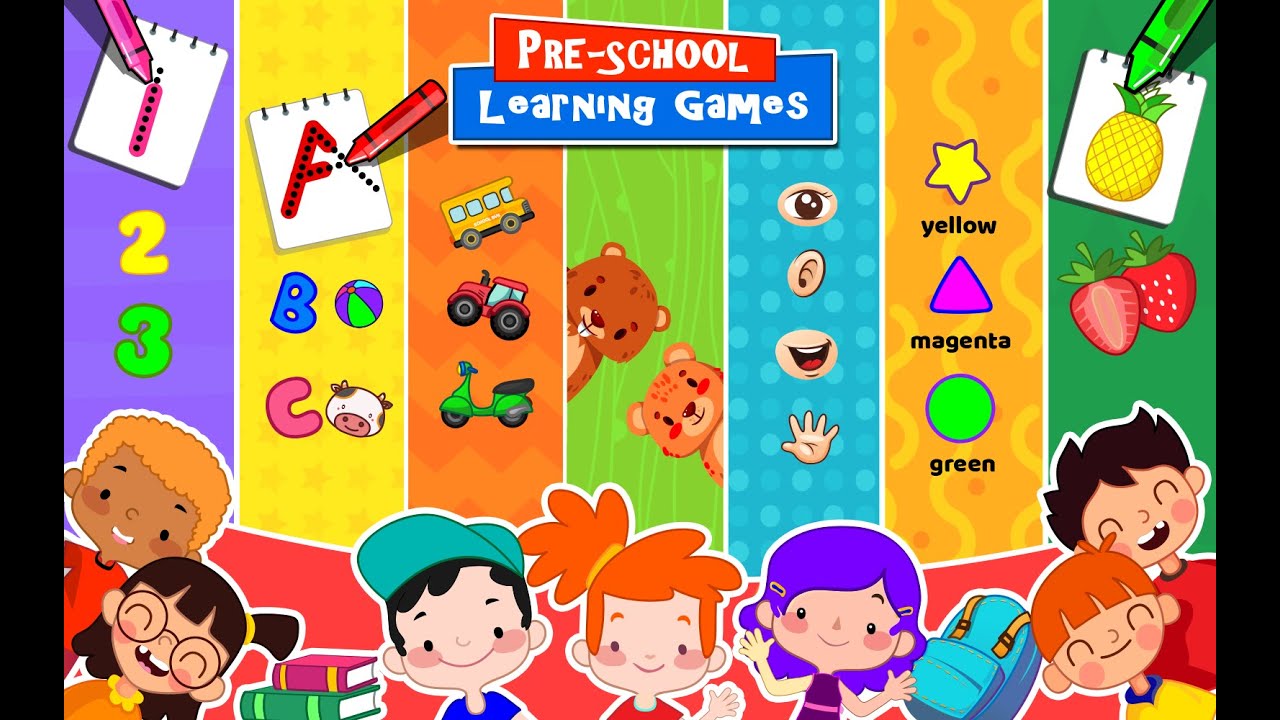
The best apps for preschoolers aren’t just cartoons; they are interactive experiences. Look for games where the child has to trace letters to move a character or solve a puzzle to hear the next part of a story. These games use multi-sensory learning, combining sight, sound, and touch. This helps the information “stick” better than just looking at a picture in a book.
Logic and Problem Solving Games
There are many fantastic games designed to teach the basics of coding and logic to four-year-olds. These usually involve “if-then” scenarios—for example, “If you move the arrow right, the monkey gets the banana.” This teaches cause and effect and sequential thinking. It’s about teaching them how to think, not just what to think.
Social-Emotional Learning Through Group Play
We often focus on ABCs and 123s, but social-emotional learning (SEL) is arguably more important in the preschool years. Games played with peers or parents teach children how to navigate the messy world of human emotions.
Board Games and the Art of Losing
Classic board games designed for little ones—think “Candy Land” or “Chutes and Ladders”—are masterclasses in patience and resilience. Learning that you won’t always win is a massive milestone. It teaches them to handle disappointment and celebrate others’ success. Plus, the simple act of moving a piece three spaces forward reinforces one-to-one correspondence in math.
Role Playing and Imaginative “House”
Setting up a “grocery store” or a “doctor’s office” in your playroom is a game that builds vocabulary and empathy. When a child pretends to be the cashier, they are practicing social scripts and learning how to interact with others in a structured way. They are also using their imagination to transform a cardboard box into a cash register, which is a high-level cognitive skill called “symbolic representation.”
Making Learning a Natural Part of Your Day
The beauty of educational games is that they don’t have to be a scheduled “event.” You can turn a trip to the grocery store into a game of “Find the Letter A” or a car ride into a “Rhyming Challenge.” The more you integrate these playful moments into your routine, the more your child will view learning as an adventure rather than a chore.
When we prioritize play, we aren’t just preparing kids for kindergarten; we are fostering a lifelong love of discovery. A child who enjoys solving a puzzle or winning a word game is a child who will eventually enjoy solving a math problem or writing an essay. It all starts with those early, “silly” games played on the living room floor.
—
Conclusion
Educational games are the secret sauce of preschool development. By blending movement, digital tools, and social interaction, we provide children with a holistic learning environment that meets them exactly where they are. Whether it’s a high-tech app or a simple game of hide-and-seek with alphabet blocks, the goal remains the same: to spark curiosity and build confidence. Remember, at this age, the goal isn’t perfection—it’s engagement. So, grab some blocks, open an app, or just start a scavenger hunt, and watch as your child’s world expands one game at a time.
—
Frequently Asked Questions
How much time should my preschooler spend on educational apps each day?
While every family is different, experts generally recommend limiting high-quality screen time to about one hour per day for children aged two to five. The focus should always be on “co-viewing” or playing together to maximize the educational benefits.
Can games really replace traditional workbooks?
For the preschool age group, absolutely. Research shows that play-based learning is more effective for long-term retention in young children than rote memorization or worksheets, as it engages more areas of the brain simultaneously.
What are the best games for kids who have trouble sitting still?
Focus on “gross motor” educational games. This includes things like “Alphabet Hopscotch,” where they jump on letters called out by a parent, or “Bean Bag Math,” where they toss bags at numbered targets.
How do I choose a game that isn’t too hard or too easy?
Look for the “Zone of Proximal Development.” This is a fancy way of saying the game should be just challenging enough that they need a little help, but not so hard that they get frustrated and quit. If they can do it 70% of the time on their own, it’s a good fit.
Do I need to buy expensive educational toys?
Not at all! Some of the most effective “toys” are household items. Tupperware can be used for sorting, socks can be used for matching colors, and a simple deck of cards can teach everything from numbers to patterns.